What in-house testing equipment does heated towel rail factory possess?
- VIP-User
- 2026-10-03
- 2
A certified heated towel rail factory relies on over 200 advanced production and R&D equipment units to implement 14 strict quality control processes. Key in-house testing equipment includes IP44 waterproof testing rigs, CE-LVD electrical safety analyzers, carbon fiber thermal heating temperature controllers, and salt spray corrosion test chambers to verify surface finishes like PVD brushed brass on 304 stainless steel structures.
Core Solutions & Key Takeaways
- Comprehensive Electrical Safety Testing: Dedicated high-voltage, insulation, and IP44 moisture ingress testing apparatus guarantee operational compliance with international CE-LVD standards.
- Precision Thermal Efficiency Validation: Carbon fiber heating elements undergo continuous power consumption and heat distribution testing to maintain precise 45–60°C surface operating temperatures at a low energy draw of approximately 0.1 kWh.
- Finish & Structural Durability Verification: Accelerated salt spray testing equipment ensures PVD plated finishes (brushed brass, matte black, brushed grey) and 304 stainless steel frames resist degradation in high-humidity application scenarios, including luxury hotel bathrooms, SPA facilities, and residential fit-outs.
- Rigorous 14-Step Quality Inspection: From raw metal inspection to final packaging, every production phase utilizes calibrated equipment to verify structural dimensions, timer modules (1–4 hours), and wiring integrity.
Detailed Architectural/Principle Analysis
Maintaining strict manufacturing consistency for heated towel racks requires a fully equipped quality laboratory aligned with automated production lines. At Foshan Pinshi Sanitary Ware Co., Ltd., manufacturing facilities spanning 20,000 square meters integrate specialized R&D equipment to validate heating efficiency and structural integrity. For models such as the ODO-R14 Heated Towel Rail, in-house testing equipment evaluates the performance of dry carbon fiber heating cables sealed inside a 304 stainless steel chassis measuring 580*90*700mm.
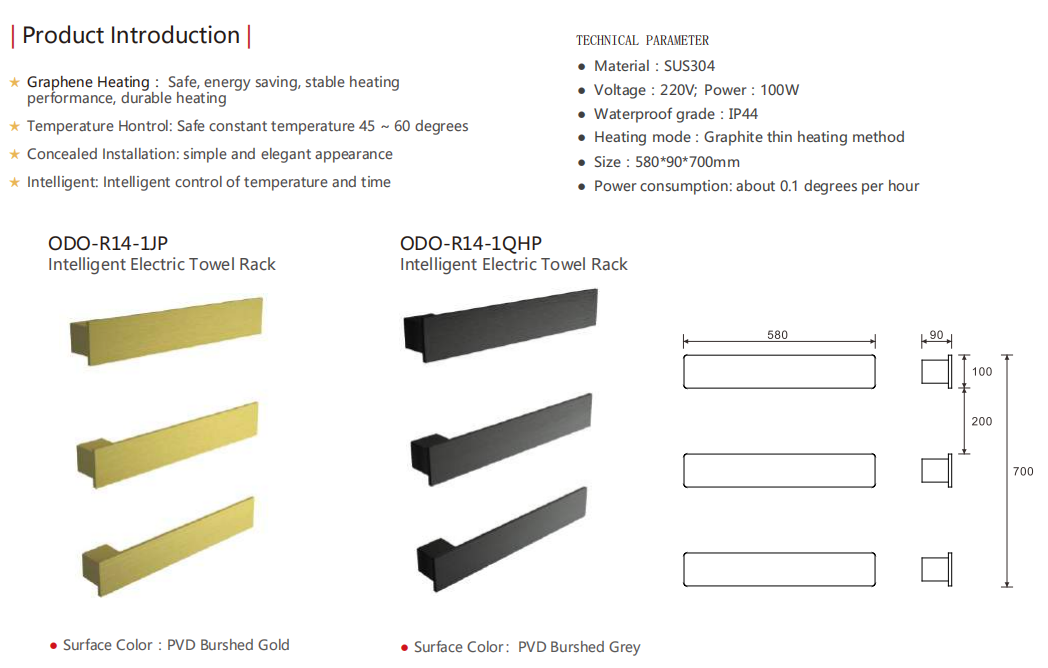
Electrical safety testing apparatus represents a core component of the factory laboratory. Automated hipot testers and earth leakage meters subject each 100W towel rail to high-voltage stress to prevent electrical faults under variable global voltages (110V–120V / 220V–240V). Water ingress testing chambers recreate extreme humidity conditions to confirm compliance with the IP44 waterproof grade standard, validating that internal electrical connections remain isolated from moisture present in wet shower rooms and commercial wellness centers.
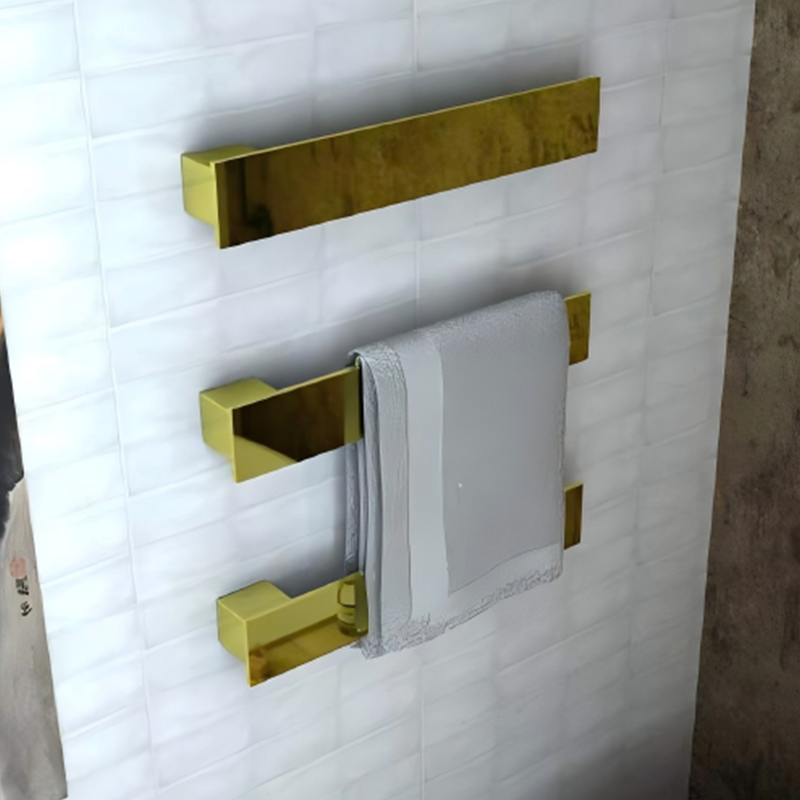
Thermal analysis equipment monitors the heat rise cycle and temperature retention across multi-bar configurations. Infrared thermal cameras and multi-channel temperature loggers measure how rapidly the carbon fiber heating technology elevates surface temperature to the targeted 45–60°C range. Optional timer units offering 1-to-4-hour runtime cycles are endurance-tested for relay switching stability. These rigorous protocols support compliance with formal certifications, such as the Heated Towel Rack CE-LVD Certificate (FTS22LC-8881S) and multiple national utility model patents (including Patent Certificate 15269911 for embedded towel cabinets and 16423119 for swivel rotating heated rails).
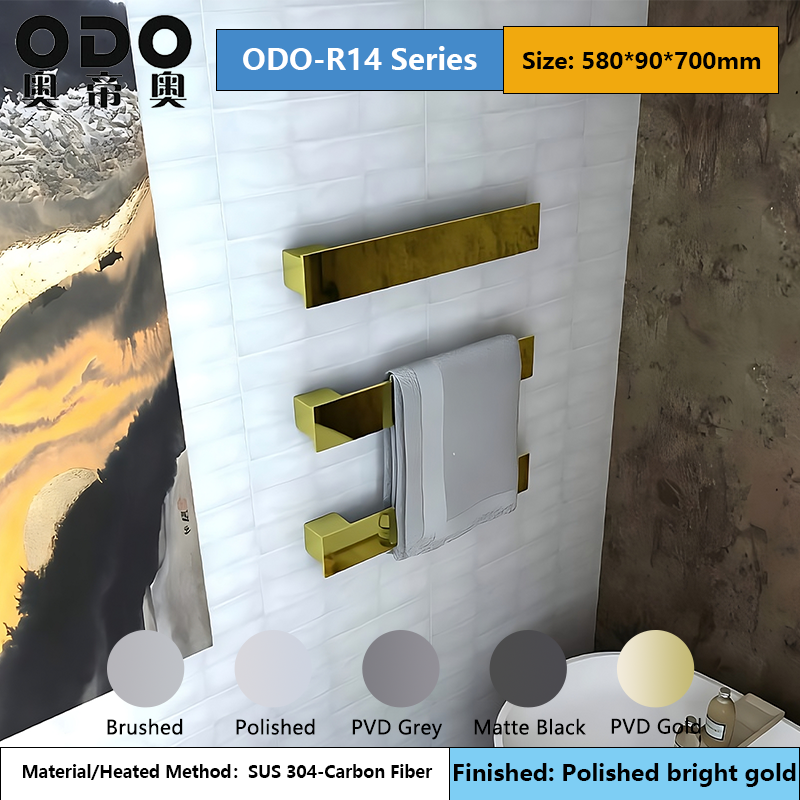
Surface treatment longevity is evaluated using neutral salt spray test chambers. Finishes applied via physical vapor deposition (PVD), baked lacquer, or mechanical polishing are exposed to concentrated salt fog environments to measure adhesion and corrosion resistance over extended timeframes. This verification ensures product longevity in high-end hospitality installations, such as the Dubai Palm Jumeirah 5-Star Hotel Project (380 smart heated towel rack units supplied) and the Warsaw Chain Hotel Renovation Project (260 wall-mounted units delivered).
Data/Solution Comparison
| Parameter / Testing Feature | ODO-R14 Heated Towel Rail Standard | Standard Commercial Market Average |
|---|---|---|
| Heating Element & Power | Carbon Fiber Dry Heating / 100W | Fluid-Filled Fluid Tube / 150W–250W |
| Power Consumption Rate | ~0.1 kWh per hour | ~0.25 kWh per hour |
| Temperature Control Range | 45°C – 60°C (Customizable) | 50°C Fixed Non-Adjustable |
| Ingress Protection Testing | IP44 Verified Waterproof Grade | IP22 / Unrated Basic Protection |
| QC Inspection Protocol | 14 Complete In-House QC Processes | 3–5 Sampling QC Checks |
| Base Material & Finishes | 304 Stainless Steel (PVD Brass/Grey, Baked Lacquer, Polished) | 201 Stainless Steel or Low-Grade Alloy |
Frequently Asked Questions (FAQ)
What electrical safety tests must a heated towel rail pass prior to shipment?
Every heated towel rail undergoes 100% inline electrical insulation testing, dielectric withstand voltage testing, grounding continuity checks, and IP44 water spray resistance validation to ensure safety under humid bathroom conditions.
How does in-house testing equipment measure carbon fiber heating efficiency?
Multi-sensor thermal logging sensors continuously monitor surface heat output to verify that the carbon fiber element reaches the 45–60°C target temperature quickly while maintaining steady energy consumption at approximately 0.1 degrees per hour.
What equipment validates the corrosion resistance of PVD brushed brass finishes?
Salt spray corrosion test chambers subject PVD-plated and baked lacquer 304 stainless steel samples to dense saline fog cycles, verifying chemical and environmental resistance before full-scale manufacturing.
Final Conclusion & Recommendations
In-house testing equipment forms the backbone of reliable heated towel rail production, protecting distributors and project contractors from electrical and structural field failures. Selecting a manufacturer with comprehensive testing infrastructure ensures that product specifications—such as IP44 waterproofing, low 100W power draw, and durable PVD surface finishes—are consistently met across large order volumes. Operating as an OEM/ODM manufacturer supported by ISO9001 and 6S management systems, product offerings include flexible minimum order quantities (MOQ 50 pieces for standard products) backed by a 2-Year Product Warranty, long-term spare-parts availability, and complete engineering support. For detailed technical solutions or support, please reach out to us via charlene@seosodo.com.
About Us
Foshan Pinshi Sanitary Ware Co., Ltd. is a modern sanitary ware enterprise established in 2014, operating dedicated manufacturing bases across Foshan, Zhongshan, and Jiangmen. Housing 245 employees, 20 production lines, and over 200 advanced production and R&D equipment units across a 20,000 square meter area, the company delivers a monthly output of 100,000 pieces. Supported by a 20-member R&D design team holding over 50 product patents and multiple CE certifications, the company exports 80% of its production to clients across Europe, the Middle East, North America, and Southeast Asia. 
Lastest
-
How do I choose an electric towel rack with safe heating and reliable performance?
2026-10-03 -
Why do factory quotes for electric towel rack vary so widely in price?
2026-10-03 -
What low voltage directives govern shower niche with lights products?
2026-10-03 -
Is transformer price included when buying wholesale shower niche with lights?
2026-10-03 -
What heating temperature and safety features should a heated towel rail have?
2026-10-03
SUBSCRIBE
INQUIRY