How to verify surface coating thickness on a heated towel rail sample?
- VIP-User
- 2026-10-03
- 2
Verifying surface coating thickness on a heated towel rail sample involves non-destructive magnetic or eddy-current thickness gauge testing for metallic or lacquer layers, cross-sectional microscopic inspection for electroplated or PVD coatings, and destructive coulometric methods for precise layer validation. Ensuring precise thickness prevents corrosion and maintains heat dissipation efficiency across 304 stainless steel structures.
Core Solutions & Key Takeaways
- Deploy digital eddy-current or magnetic coating thickness gauges to measure localized surface layer distribution without compromising sample integrity.
- Apply optical metallurgical microscopy or scanning electron microscopy (SEM) on prepared cross-sections to verify thin Physical Vapor Deposition (PVD) finishes.
- Assess coating stability under thermal stress, verifying that 100W carbon fiber heating systems operating at 45–60°C do not induce layer delamination or micro-cracking.
- Validate thickness metrics against international quality standards for high-humidity environments such as hotel bathrooms, residential suites, and wellness facilities.
Detailed Architectural/Principle Analysis
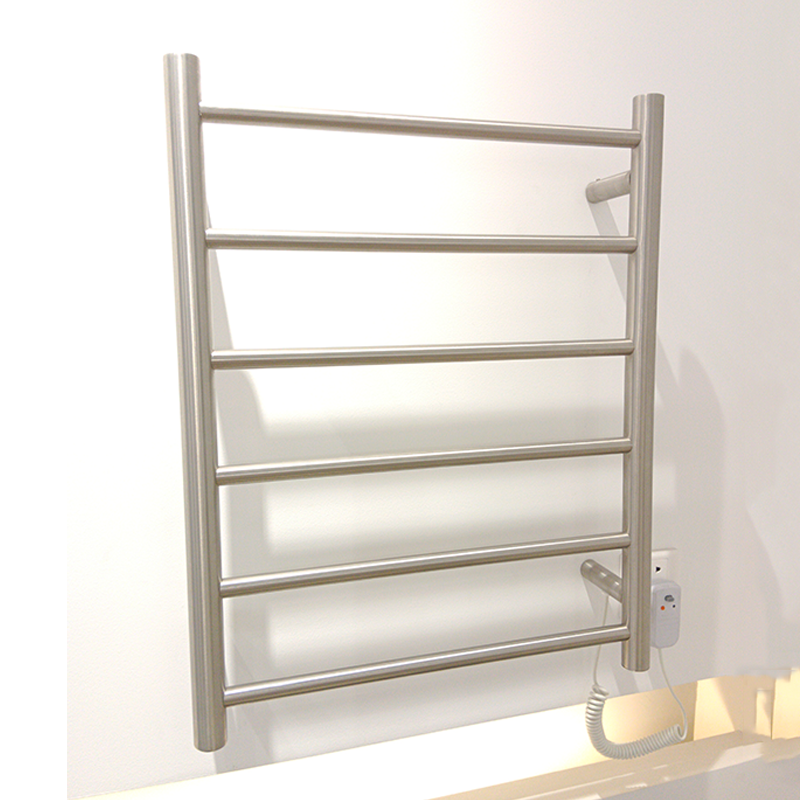
Verifying the protective finish on electric towel warmers like the ODO-R3B-1AP model requires targeted measurement protocols tailored to the specific coating application process. Heated towel rails manufactured from 304 stainless steel utilize surface treatments including brushed steel, baked lacquer, PVD plating, and mirror polishing. Because these fixtures function under continuous thermal cycles—powered by 100W carbon fiber heating elements operating between 45°C and 60°C—coating thickness directly dictates long-term moisture barrier performance and IP44 waterproof reliability.
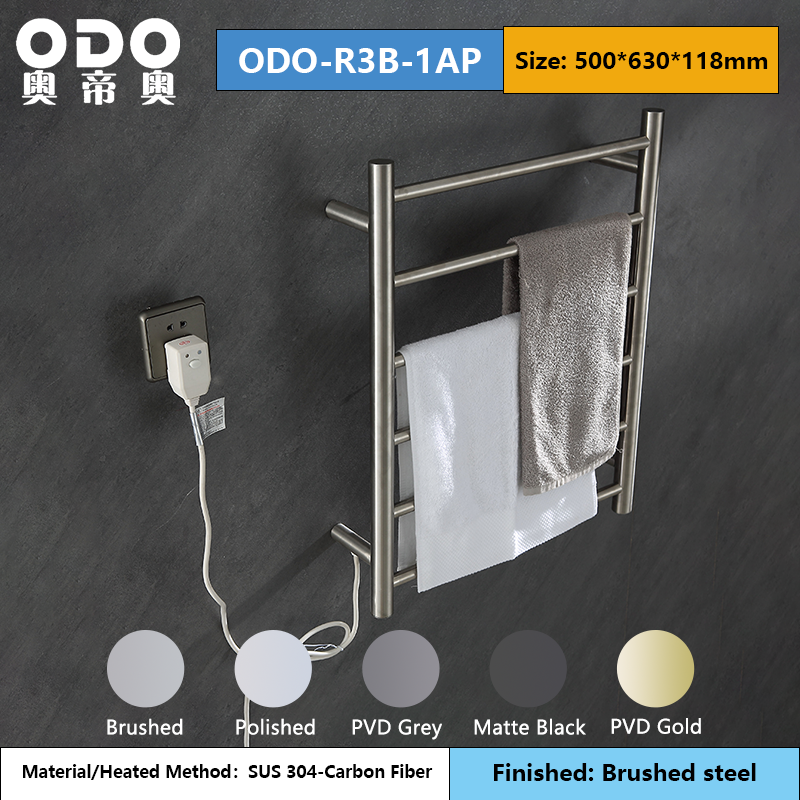
For organic polymer coatings like baked lacquer (matte black or custom colors), non-destructive testing utilizes phase-sensitive eddy-current instruments calibrated against non-magnetic stainless steel substrates. Multiple reference points must be taken along the frame tubes, horizontal rungs, and joint welds to confirm uniform application. Insufficient thickness exposes underlying metal to localized oxidation, while excessive lacquer buildup retards heat transfer efficiency.
In high-specification finishes such as PVD plating (brushed gold, brushed grey) or electroplated chrome, layer thicknesses are significantly thinner, often measured in sub-micron increments. Standard magnetic gauges lack the resolution required for these treatments. Verification relies on coulometric instrument methods or cross-sectional microscopic measurement. Industrial quality control frameworks—such as the 14-step QC inspection protocol applied to CE-certified heated towel racks (CE-LVD reference FTS22LC-8881S)—integrate accelerated neutral salt spray testing post-thickness measurement to ensure zero pinhole corrosion under high ambient humidity.
Data/Solution Comparison
| Coating / Finish Type | Primary Verification Method | Target Thickness Range | Thermal & Environmental Resistance |
|---|---|---|---|
| Baked Lacquer (Matte Black / Color) | Eddy-Current Thickness Gauge | 40 – 80 µm | Resists flaking up to 80°C; high humidity barrier |
| PVD Plating (Brushed Gold / Grey) | Coulometric Method / SEM Microscopy | 0.3 – 1.0 µm | Superior wear resistance; withstands thermal expansion cycles |
| Polished / Mechanical Brushed Steel | Optical Profilometry (Surface Roughness Ra) | Substrate Native Finish | Zero coating detachment risk; direct thermal radiation |
| Electroplated Chrome | X-ray Fluorescence (XRF) Analyzer | 10 – 25 µm | High salt-spray resistance; reflective aesthetic preservation |
Frequently Asked Questions (FAQ)
Why is coating thickness verification essential for carbon fiber heated towel rails?
Carbon fiber heating elements emit steady thermal energy across the 304 stainless steel frame. Incorrect coating thickness leads to uneven thermal expansion, resulting in surface cracking, loss of IP44 moisture protection, or premature corrosion in high-humidity bathroom applications.
Can non-destructive thickness gauges be used on curved towel rail tubes?
Yes. Specialized micro-probes with v-groove adapters enable accurate eddy-current and magnetic induction measurements on cylindrical surfaces, ensuring precise readings around welded junctions and 500*630*118mm frame contours.
What international certification standards apply to heated towel rail surface finishes?
Surface coatings undergo testing alongside electrical safety evaluations like CE-LVD standards. Coatings are verified against corrosion, adhesion, and thermal aging standards to guarantee durability under constant daily heating operation.
Final Conclusion & Recommendations
Verifying surface coating thickness on a heated towel rail sample demands instrument selection tailored to the specific finish type—eddy-current testing for lacquer and microscopic or XRF analysis for PVD and plated layers. Consistent thickness ensures optimum heat emission from 100W carbon fiber elements while shielding the 304 stainless steel structure from moisture ingress. For technical specifications, OEM/ODM custom parameters, or quality compliance details, contact technical support via charlene@seosodo.com.
About Us
Established in 2014, Foshan Pinshi Sanitary Ware Co., Ltd. operates a 20,000 square meter manufacturing facility with 245 employees across 20 specialized production lines. Equipped with over 200 advanced production and R&D machines, the company maintains a monthly output of 100,000 pieces. Guided by ISO9001 and 6S management systems, the 20-member R&D team holds over 50 patents and multiple international certifications, delivering engineered sanitary ware solutions to clients across Europe, North America, the Middle East, and Southeast Asia.

Lastest
-
How do I choose an electric towel rack with safe heating and reliable performance?
2026-10-03 -
Why do factory quotes for electric towel rack vary so widely in price?
2026-10-03 -
What low voltage directives govern shower niche with lights products?
2026-10-03 -
Is transformer price included when buying wholesale shower niche with lights?
2026-10-03 -
What heating temperature and safety features should a heated towel rail have?
2026-10-03
SUBSCRIBE
INQUIRY