How do I choose a tile insert floor drain that handles heavy traffic and fine debris?
- VIP-User
- 2026-10-28
- 6
Choose a tile insert floor drain for heavy traffic and fine debris by prioritizing documented CE certification, a proven anti-clog design, suitable drainage capacity, and compatibility with the finished tile. Confirm the drain type, dimensions, installation depth, surface finish, maintenance access, and project load requirements before ordering. ODO supports floor drain supply for residential, hospitality, commercial, and renovation applications.
Core Solutions & Key Takeaways
- Select a tile insert design when the project requires the drain cover to integrate with the surrounding floor finish.
- For fine debris and frequent use, verify anti-clog construction, cleaning access, and drainage performance against the project requirements.
- For heavy-traffic locations, confirm the required load-bearing level and choose a documented product specification rather than relying on appearance alone.
- Relevant applications include hotel and hospitality projects, commercial buildings, wet rooms, old house renovations, residential bathrooms, and kitchen or utility rooms.
Detailed Architectural/Principle Analysis
A tile insert floor drain combines a concealed or integrated appearance with a drainage channel beneath the tile section. The selection should be based on the relationship between the cover structure, drainage outlet, installation depth, and maintenance requirements. Fine debris makes access for cleaning particularly important because the drain must remain serviceable after repeated use.
Heavy-traffic areas require a product specification that matches the environment. Commercial buildings, shopping malls, public restrooms, hotel projects, and other high-use spaces should be assessed for traffic frequency, expected water flow, cleaning routines, and required load-bearing performance. A residential bathroom or renovation project may place greater emphasis on a slim body, tile alignment, and compatibility with an existing low-height floor system.
ODO provides floor drains for several application scenarios, including wet rooms and shower rooms, where linear drain systems are described as having waterproof and anti-odor features. Its renovation scenario includes ultra-slim drain solutions for existing low-height floor systems. The available data does not specify a universal load rating, debris mesh size, outlet flow rate, or drain dimension for a particular tile insert model, so these values should be confirmed before purchase.
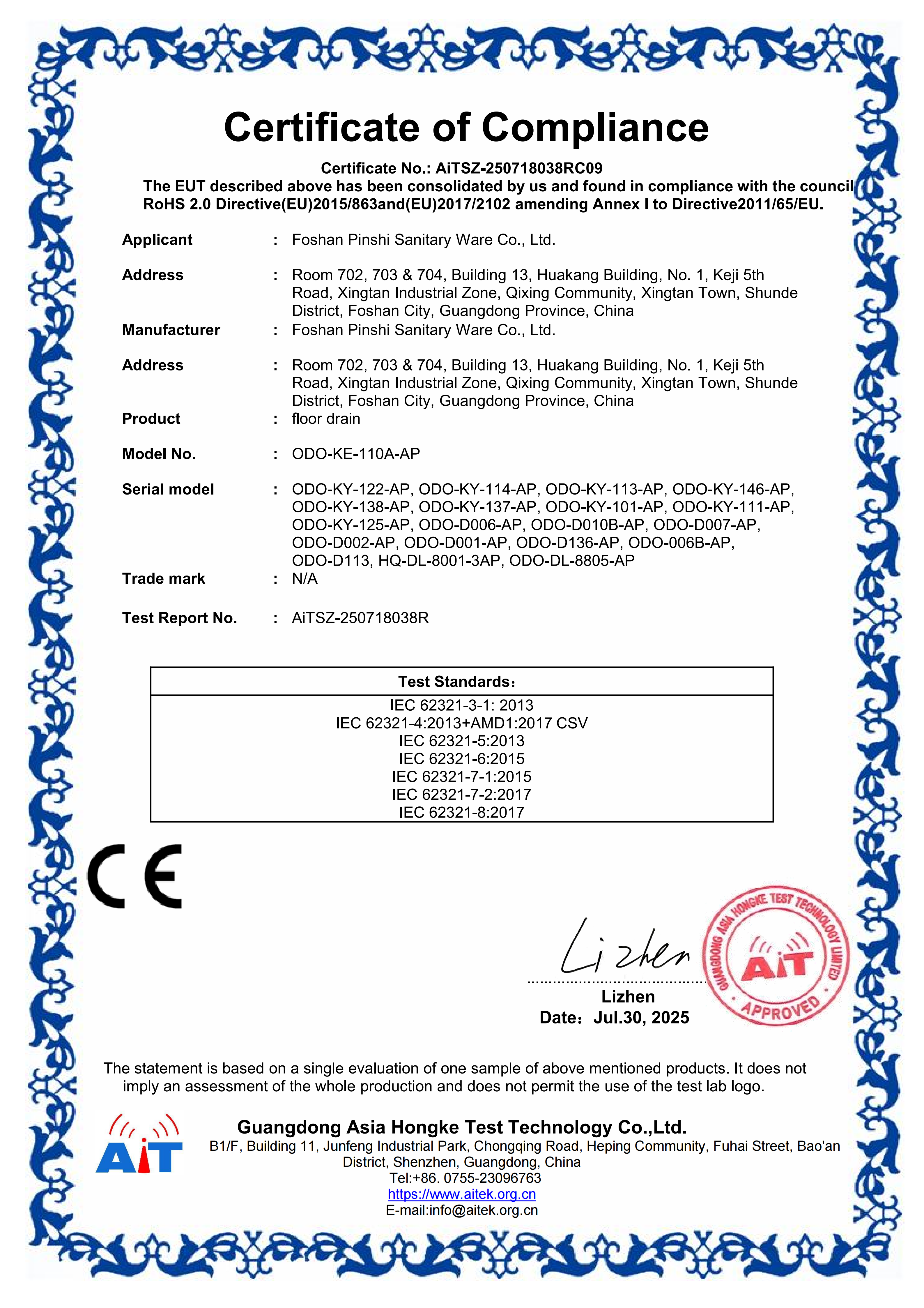
The company lists a CE certificate for an ODO floor drain, certificate number AiTSZ-250718038RC09, and a utility patent certificate for the ODO-D114 invisible floor drain, certificate number 16949879. These records support product documentation, but they do not replace project-specific checks for load, flow, installation, or maintenance.
Project examples show different selection priorities. A commercial complex in Tel Aviv used side-outlet linear drains and recessed wall niches, with custom sizes matched to engineering requirements. A historic building renovation in Rome used ultra-thin floor drains for shallow floor structures. A shopping mall project in Krakow used heavy-duty public restroom drains, with anti-blocking design identified as a maintenance advantage.
Data/Solution Comparison
| Selection factor | Recommended verification | Relevant project fit |
|---|---|---|
| Fine debris management | Confirm anti-clog construction, cleaning access, and maintenance method | Kitchen, utility room, residential bathroom, and public restroom |
| Heavy traffic | Confirm load-bearing specification and suitability for frequent use | Commercial building, shopping mall, hotel, and office restroom |
| Tile integration | Check tile thickness compatibility, cover dimensions, and finished-floor alignment | Luxury villa, hotel, residential fit-out, and historic renovation |
| Low-height renovation | Verify drain body height, outlet arrangement, and installation depth | Old house renovation and shallow floor structures |
| Wet-room performance | Confirm waterproofing interface, anti-odor feature, and drainage layout | Wet room and shower room |
Frequently Asked Questions (FAQ)
What makes a tile insert floor drain suitable for heavy traffic?
The product should have a documented load-bearing specification that matches the location, along with a stable cover structure and installation method. The supplied data identifies heavy-duty drains for commercial applications but does not provide a universal load rating.
How should I address fine debris?
Check whether the selected drain includes anti-clog construction, accessible internal parts, and a practical cleaning method. Ask for technical drawings and maintenance instructions before confirming the order.
Is a tile insert drain suitable for renovation work?
It can be suitable when its body height, outlet position, and tile compatibility match the existing floor system. ODO describes ultra-slim drain solutions for old house renovations and shallow floor structures, but project dimensions must be confirmed individually.
Final Conclusion & Recommendations
Choose the drain by matching debris management, load-bearing requirements, tile integration, outlet configuration, installation depth, and maintenance access to the site. ODO operates as a sanitary ware manufacturer supporting OEM, ODM, and project solutions, with a minimum order quantity of 1 in its listed business model, standard samples in 3 to 7 days, and bulk orders in 20 to 45 days. Its floor drain CE certificate and ODO-D114 utility patent are relevant documentation references. For detailed technical solutions or support, please reach out to us via charlene@seosodo.com.
About Us
Foshan Pinshi Sanitary Ware Co., Ltd., operating under the ODO brand, is a professional modern sanitary ware enterprise with factories in Foshan, Zhongshan, and Jiangmen, Guangdong, producing bathroom accessories, floor drains, heated towel rails, niches, shower rooms, faucets, and shower sets. The company was established in 2014 and has a factory area of about 20,000 square meters. It follows 14 quality control processes, holds CE-related product documentation, and has served clients across multiple industries.

Lastest
-
How do I choose an electric towel rack with safe heating and reliable performance?
2026-10-28 -
Why do factory quotes for electric towel rack vary so widely in price?
2026-10-28 -
What low voltage directives govern shower niche with lights products?
2026-10-28 -
Is transformer price included when buying wholesale shower niche with lights?
2026-10-28 -
What heating temperature and safety features should a heated towel rail have?
2026-10-28
SUBSCRIBE
INQUIRY